

What is a DAF (Dissolved Air Flotation) System?
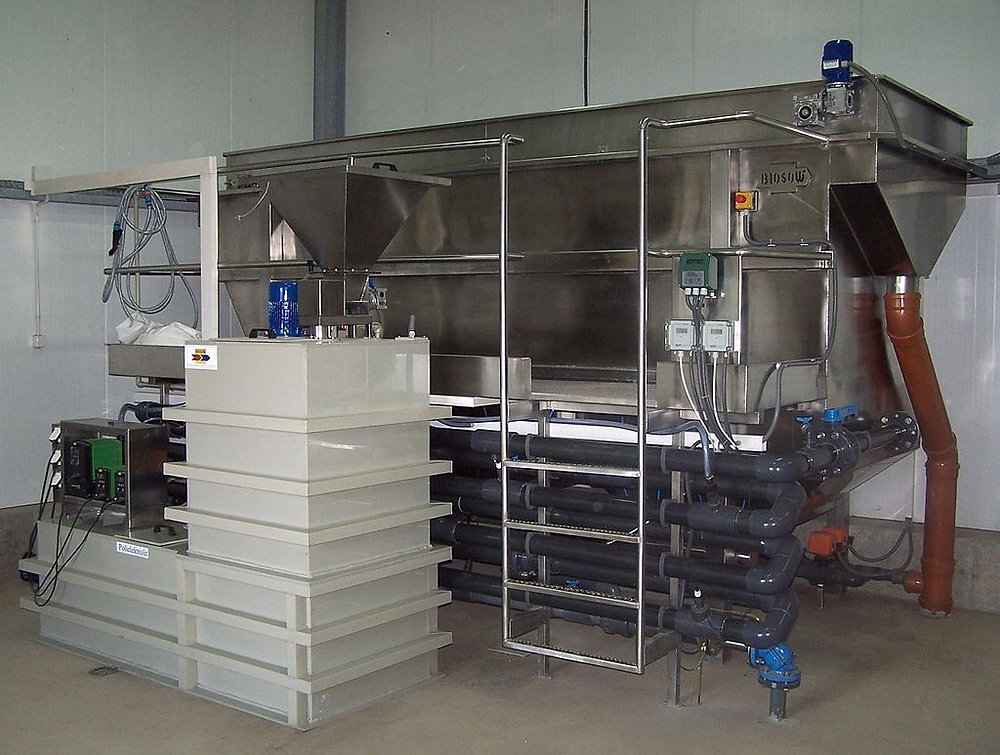
Dissolved Air Flotation (DAF) is a physicochemical process where chemistry is adjusted to physically remove pollutants from wastewater.
 A dissolved air flotation unit
This is a physicochemical process, meaning both physics and chemistry play a role. It is suitable for cases where chemistry can be configured to physically separate contaminants from the wastewater.
The core concept is the separation of wastewater into clarified effluent and sludge by floating the sludge using dissolved air.
The DAF system is particularly suitable for any matter that tends to float naturally but does so very slowly, such as oils and fats, which often do not settle in a standard physicochemical process. In these cases, using a clarifier (Settler) is inefficient; instead, we choose a DAF system, which is a relatively simple process compared to sedimentation, biological treatments, or other complex methods.
Every DAF system includes a vessel or pipe where air is dissolved into the water at a pressure of 4 to 6 BAR. This air-saturated water is called "white water." The white water is injected into the DAF tank. The air bubbles begin to expand. As the bubbles grow and rise, they collect solids along the way. Additionally, because the air originates in a dissolved state, it penetrates the flocs or particles, giving them buoyancy.
A DAF system includes pretreatment stages and a flotation tank.
For a DAF system to operate effectively, pretreatments are required before the wastewater enters the unit. These pretreatment stages generally include pH adjustment, coagulation, and flocculation. If these processes are absent or unbalanced, the DAF system will typically fail to function properly.
Following pretreatment, the wastewater enters the DAF flotation tank with flocs—clumps of sludge—that rise and float on the surface of the wastewater. At the top, a surface skimmer scrapes the sludge out of the flotation tank.
Usually, the sludge leaving the DAF flotation tank is thin, meaning it contains a high liquid content. Therefore, the sludge undergoes a dewatering process such as a filter press, decanter centrifuge, other types of centrifuges, or filter bags (Big Bags). While the clarified effluent leaving the DAF is free of suspended solids, it still contains dissolved matter. Anything in the dissolved phase—such as sugars, organic matter, or metals that have not been precipitated—will not be removed by the DAF system. As a general rule, it is important to remember that not all organic matter is removed by a DAF unit. To determine if a specific organic substance can be removed via DAF, one must ask a simple question: Is the substance present in the water as a solid or as a dissolved solute?
Many companies have developed other types of flotation units that are not DAF-based. In some, for example, air is compressed into the flotation tank without being dissolved. In most non-DAF flotation systems, the air distribution is uneven, resulting in inferior separation of solids from the clarified effluent.
From my experience, among the various types of flotation systems available today, the DAF system is the most cost-effective and efficient.
There are many companies that manufacture DAF systems.